How Minor Tweaks to Your Headlines Can Boost Conversions

Recently, I had the pleasure of once again watching a webinar from Marketing Experiments, this time on headline optimization. The research firm, who also produces Marketing Sherpa, regularly shares their findings with online marketers to help us perfect our craft.

For this webinar, the research team at Marketing Experiments focused on headlines.

Headlines constitute the most important part of your site’s copy – landing pages in particular must have a strong headline in order to grab the reader’s interest. In the fast paced world of online marketing, you must construct a headline that succinctly describes what your page is about and what the reader can expect by reading more.

Headlines are also perhaps the easiest (…and most important) thing to change on a webpage. So if your site is loaded with landing pages, it shouldn’t take hours of your time to make some minor tweaks.

Doing so could result in dramatically more conversions, which is the holy grail of any webpage you post on your site.

In ME’s webinar, the team organized headlines from highest performing to lowest, which reveals certain patterns marketers can take away.

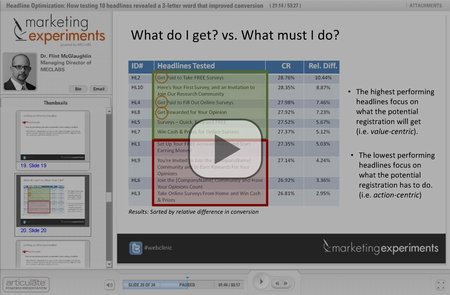
One such pattern is the more top-performing headlines emphasize what the reader will get by reading more. In technical terms, this is what ME calls a ‘value-centric’ headline. The other noticeable pattern for top-performing headlines is ones where the value point was positioned at the beginning of the headline.

Consider the following example from the webinar:

Get Paid to Take FREE Surveys vs. Take Online Surveys from Home

Which headline do you think saw more conversions?

According to the data, the first headline experienced over twice the amount of conversions because it emphasized what the reader will get.

From analyzing conversion data for 10 different headlines, the team at Marketing Experiments was able to derive two key principles to keep in mind when crafting your landing page headlines.

1.       Interests of the customer must be the central focus of all headlines and marketing messages. Emphasize what the reader will get rather than what they must do.

2.       Headlines can be compared to the opening scene of a movie in that each must ‘arrest’ the visitor’s attention at the beginning.

When considering these two principles, it’s best to use what ME calls a ‘point-first’ structure, meaning you place the value of what you offer right at the beginning of the headline.

One interesting comparison to consider, especially if you’re a guy trying to write landing pages, is the similarity between headlines and ‘pick-up’ lines. Every guy knows you can’t get the girl’s phone number immediately. You have to draw their interest and start a conversation, which is exactly what headlines and landing pages do.

That’s why you can’t rush your call-to-action. You can’t have a conversation before your opening line. And you can’t get someone to do something without having that conversation, which is exactly like trying to talk a girl you really like.

So to really develop headlines that work, use a ‘point-first’ structure and place the value of what you offer the reader at the very beginning.

Click the image below and watch the webinar for more. Or click here to see the webinar in other formats. And feel free to let us know how this works for you. We’ll be changing a few headlines here and there and report back on our own findings.

Click Image to View Webinar (opens in a new window)

Related Posts

Maximize Conversions by Following These 9 Steps for Writing the Ultimate Landing Page

Eyetracking Study Reveal Users Read Webpages in an F-Shaped Pattern

Test Headlines with the “Breath” Test

Getting Rid of Conversion Killers in your Copy

Beware of Your Page’s Primary Purpose When Writing Content

Images vs. Copy – Finding the Right Balance

Recently, I had the pleasure of watching an hour long webinar on images and copy on a webpage. The presentation was by our friends at Marketing Experiments.

And while this webinar is a little old now (originally airing in November), it contains some great commentary on how web marketers can approach and find the right balance between images and copy on their webpages.

Perhaps the biggest take-away I got from the webinar was this – “People don’t buy from websites, they buy from people”

This is perhaps one of the most insightful comments on web marketing I’ve ever heard and will do my best to remember it going forward. But for now, let me give you a quick review of the presentation and invite you to take an hour to watch it yourself – you certainly won’t come away disappointed.

Starting out, Marketing Experiments director Dr. Flint McGlaughlin explained how a lot of things common to websites pose impediments to conversions. Perhaps you know what he’s talking about here – many websites contain or don’t contain elements that prevent you from getting the maximum amount of conversions.

That’s where the Principle of Congruence comes in, which requires every element of a page state or support your page’s value proposition.

Say your value proposition is custom-made products shipped fast – do all of the elements of your page work to support this value proposition?

Images or Copy – Which do I focus on more?

When approaching this question, you need to ask yourself what communicates value more effectively – images or copy – according to Flint and the researchers at MECLABS.

The effectiveness of any webpage element to communicate the value proposition can be measured by the following two capabilities:

1.       Ability to communicate value with force

2.       Ability to communicate value with precision

When considering images and copy, keep in mind that images have a greater potential to communicate value with force and copy has greater potential to communicate value with precision.

Images

The force of an image is directly related to three things:

1.       Relevance – an image’s force increases as the connection between the image and perceived value becomes clearer. Images are great for communicating brand.

2.       Reality – an image’s force increases with its authenticity. Images can reduce the distance between the actual value and the reader’s perception of that value (see example in slide #23).

3.       Relative Weight – an image’s force increases as its relative graphical proportion increases…or in layman’s terms, images that look different than other elements on a page get your attention. This naturally draws the reader’s eye-path. Therefore, if the image provides proper relevance and reality, it will bring more force to bear on the inherit value.

Copy

In short, copy has two distinct advantages over images.

First of all, copy has the ability to include specific, quantifiable detail to your webpage. Secondly, copy gives your site personality and has the ability to include a tone that matches your visitors’ motivations.

Of course, there’s a right way and wrong way to use copy. You don’t want to use phrases that make you seem arrogant – examples include “Your Hunt is Over” and so on.

Also, be careful about your call-to-action copy. In their example (slide #30), a form has an intimidating tone that seems to imply that you will receive incessant phone calls from sales people once you complete it.

What about SEO?

Last but not least, Dr. Flint and the team at MECLABS explored the impacts all of this has on search engine optimization. How do you balance landing page optimization (LPO) with SEO?

In a sense, SEO is a secondary concern. You first need to work on maximizing conversions and then worry about boosting search rankings afterwards. There are many examples of high-ranking pages that fail to convert because the site owner focused solely on SEO, which according to Dr. Flint is just a channel to get people to your page. In other words, it’s a means to an end, not the end itself.

They outlined some questions to consider when identifying the proper balance between SEO and LPO:

1.       Where does your traffic come from? If it’s organic, how well does it convert visitors into customers?

2.       What are your needs in terms of LPO and what’s its potential impact? Are the needs radical or minor? How much will these changes affect your bottom line?

3.       What contributes the most to your SEO ranking – content or authority?

4.       Can you measure the impact of page changes?

After discussing some ways to identify the proper SEO/LPO balance, Dr. Flint and the team evaluated a couple of sites given to them by one of the webinar’s original participants and offered tips on how to strike the right balance between images and copy to maximize conversions.

In the end, the webinar is well worth the one-hour it takes to watch it and take some notes. I’m sure I’m leaving something out since it was so extensive and informative. Watch the video or tell us about your experiences in using images and copy and how well your balance worked to increase conversions.

Click image to see video presentation

Click image to see video presentation

Or listen to an audio version here.

Until next time…